Aerospace, Global, Mro, News, Singapore


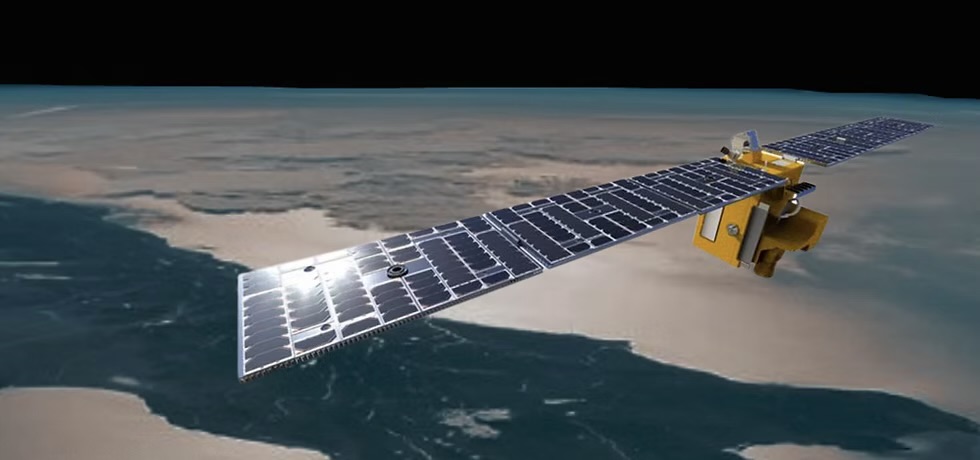
Gilmour Space’s ElaraSat. Photo: Gilmour Space Technologies
Singapore-based laser communications startup Transcelestial is expanding its global footprint through a long-term partnership with Australian aerospace engineering firm Gilmour Space Technologies. The collaboration aims to demonstrate and advance optical laser communications technology for Gilmour Space’s satellite network.
Announced in February 2026, the collaboration will see Transcelestial’s optical communication terminals integrated onto Gilmour Space satellite platforms, beginning with an in-orbit qualification mission later this year.
The first demonstration will see Transcelestial’s laser communications terminal hosted on Gilmour Space’s ’s ElaraSat MMS-2 satellite bus, scheduled to launch aboard SpaceX’s Transporter-18 rideshare mission later this year. A live in-orbit demonstration is slated to be conducted to evaluate the performance of wireless laser communications in actual operating conditions and assess readiness for broader deployment across future missions.
Such a partnership is significant for the global space sector as it addresses a particular issue that most satellite operators are growing increasingly concerned over: an increasingly distant gap between the amount of data a spacecraft can generate and the rate at which spacecraft can deliver data to users on Earth.
As satellites increasingly depend on high-resolution sensors, and support time-sensitive, data-heavy workloads, legacy radio frequency (RF) receiver systems are coming under growing strain. Bandwidth constraints and spectrum congestion are prompting industry players to explore alternative solutions to support next-generation data demands.
“Satellites are not just sensors in orbit anymore but are becoming full blown orbital data centers, and the network layer is now falling behind… Gilmour Space’s satellite capabilities are rapidly expanding and their bus is going to be one of the first in the world to be laser comms enabled by default. This capability puts them ahead of most bus manufacturers in the world and we are quite excited to see what this unlocks for the industry,” said Rohit Jha, CEO and Co-Founder of Transcelestial.
Transcelestial’s laser communications technologies is based on free-space optical communications, using tightly focused laser beams to transmit data between satellites and ground stations. Compared to RF systems, optical links can support significantly higher data rates and narrower beam divergence, which also reduces unintended signal interception. This maximises security when transmitting data between satellites, and from satellite to ground. According to Transcelestial, it also provides resistant communications against jamming and interception, leveraging secure systems to keep communications safe down to the quantum level.

Transcelestial optical communications terminal. Photo: Transcelestial
Transcelestial’s inter-satellite space lasers can reach speeds of up to 10 Gbps depending on distance while space-to-ground links are designed for high-bandwidth downlink speed of up to 10 Gbps over ranges up to 1500 kilometres..
However, optical communications remain sensitive to environmental factors such as cloud cover, atmospheric turbulence, and heavy precipitation. To address this, Transcelestial also relies on networked optical ground stations distributed across geographically diverse locations to maintain link availability, along with adaptive power and tracking systems.
Transcelestial has previously announced plans to develop an optical ground station in Alice Springs, positioning it as part of a broader distributed ground network designed to support space-to-Earth laser links. More recently, the company has indicated plans to expand deployment activities in Australia’s Northern Territory.
The company already operates optical ground infrastructure in Europe, which forms part of its early global network for testing and validation of space-to-ground laser communications.
In Australia, future development discussions with Gilmour Space include the potential to co-develop an optical ground station in Queensland, as well as joint requests for Australian funding for research and development.
Beyond space applications, Transcelestial also positions its technology as a complementary layer to existing communications infrastructure, particularly in geographically dispersed regions like Australia.
“Australia has vast coastlines that are difficult to monitor and protect at scale, especially across sparsely populated regions,” said Transcelestial CTO and co-founder Mohammad Danesh. “At the same time, national connectivity risk is concentrated through a small number of subsea fibre routes. If those routes are disrupted, critical digital infrastructure can be impacted quickly, and existing fallbacks like satellite internet have bandwidth limitations. Laser communication offers secure, high-bandwidth connectivity layer that can support resilience planning for population centres and sensitive operating environments,” he added.
The company is exploring plans to establish up to three optical ground stations across Australia, as it builds out a broader space-to-ground laser communications network in the region.






Welcome to the Aerospace Singapore Digital beta site! Feel free to explore, leave your feedback, or sign up for our mailing list!
Sign up for our free newsletter and never miss a beat! Be the first to know about our latest articles, latest news and trends in our industry.